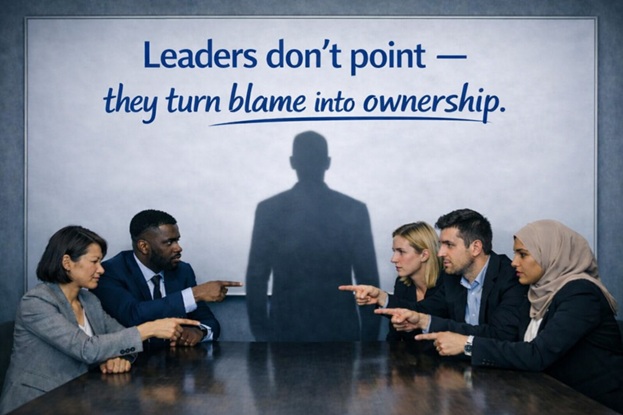
I’ve been in those rooms — the ones where you can feel the air change. Something broke. A deadline slipped. A client wasn’t happy. You can watch an entire team brace for impact. People get quiet. Eyes drop. Everyone starts calculating their exposure.
And then someone stands up and says, “I’ll take responsibility. Let’s get to the solution.”
No qualifiers. No hedging. And often, not even the person who made the mistake.
But the room shifts instantly. Shoulders drop. People breathe again. The defensive fog lifts, and the collective intelligence of the group comes back online.
That moment taught me something I’ve carried into every leadership role since: ownership isn’t self‑sacrifice — it’s strategy. You’re not absorbing punishment. You’re redirecting the room’s energy from fear to clarity.
Two Cultures Under Pressure
When something breaks, you see a company’s real operating system. You get one of two cultures:
- Blame culture — people protect themselves, hide information, and spend their energy crafting cover stories.
- Accountability culture — people surface problems early, learn fast, and move toward solutions.
Blame culture is expensive. Fear-based leadership costs billions in lost productivity. Leaders lose hours every week to micromanagement and anxiety. Teams stop speaking up. Innovation collapses.
Accountability culture works differently. Blame looks backward. Accountability looks forward. When leaders take responsibility — even for things they didn’t personally break — teams follow suit. They stop hiding problems and start fixing them.
The Dynamics of Blame Energy
Blame has a dynamic to it. When tension fills a room, that energy has to go somewhere. If no one steps up, it ricochets around the team:
- People shut down.
- Information gets withheld.
- Creativity disappears.
- Everyone focuses on self‑protection instead of problem‑solving.
But when a leader says, “I’ll take responsibility. Let’s move forward,” they absorb that energy and convert it. Not as a martyr — but as a strategist.
The emotional center of gravity shifts. People stop defending and start solving. The room moves from fear to clarity.
Teams respect leaders who take a stance, even if adjustments come later. Certainty under pressure builds trust. Trust builds performance.
Psychological Safety Is a Leadership Output
Most leaders miss this: psychological safety isn’t an HR initiative — it’s a leadership behavior.
Google’s Project Aristotle found that psychological safety was the single strongest predictor of team performance — stronger than talent, experience, or technical skill.
But only a fraction of leaders actually create it. The rest wonder why their teams stay quiet, avoid risks, or hide problems until they explode.
When people feel safe:
- Productivity jumps.
- Innovation rises.
- Turnover drops.
- Underrepresented team members stay four to six times longer.
Psychological safety is built through repeated demonstrations that mistakes won’t trigger blame spirals. When leaders take ownership openly, they teach everyone else that accountability is safe — and expected.
That early‑warning system becomes a competitive advantage.
Punishment vs. Accountability
Most people confuse these two — and the confusion costs them.
- Punishment asks: “Who did this?”
- Accountability asks: “What do we learn, and how do we prevent it?”
Punishment trains people to hide mistakes. Accountability trains people to fix them.
One optimizes for short‑term blame assignment. The other optimizes for long‑term performance.
Leaders who create accountability cultures don’t just get better results — they get problems surfaced early, when they’re still small enough to solve.
The Strategic Misunderstanding
People often misread ownership as noble self‑sacrifice — the leader falling on their sword.
Wrong frame.
Taking ownership is a high‑leverage move. You’re choosing where the room’s energy goes. You’re choosing clarity over chaos. You’re choosing to unlock your team’s problem‑solving capacity instead of watching them burn it on self-defence.
Teams that feel ownership don’t wait to be told what to do. They think in outcomes, not tasks. They care about the quality of the result because they feel responsible for it.
And that behavior is shaped far more by leadership than by personality.
What Teams Actually Need
Teams don’t need perfect leaders. Because when leaders look perfect, people start fearing they have to be perfect to. Fear leads to silence. And silence creates failure.
Teams need accountable leaders — leaders who make it safe to surface problems early, who respond with “let’s fix this” instead of “whose fault is this?”
I’ve watched rooms freeze under blame. I’ve watched rooms unlock under ownership. The difference is night and day.
When someone steps forward, tension releases. Information flows. The collective intelligence returns. People shift from “How do I avoid blame?” to “How do we solve this?”
That shift is everything.
The Leadership Move That Changes the Room
The leader who stood up and said, “I’ll take responsibility. Let’s get to the solution,” understood something fundamental:
His job wasn’t to be perfect. His job was to make it safe for everyone else to be accountable.
He absorbed the blame energy so the room could focus on the fix.
That’s not sacrifice. That’s strategy.
If you want teams that take ownership, surface problems early, and learn fast, you model the behavior first. You show them what accountability looks like under pressure. You prove that mistakes trigger learning, not punishment.
And the room shifts.
Every single time
Look out for Part 1 and part 3 of this 3 parts series at: davidcormier.ca
Leave a Reply