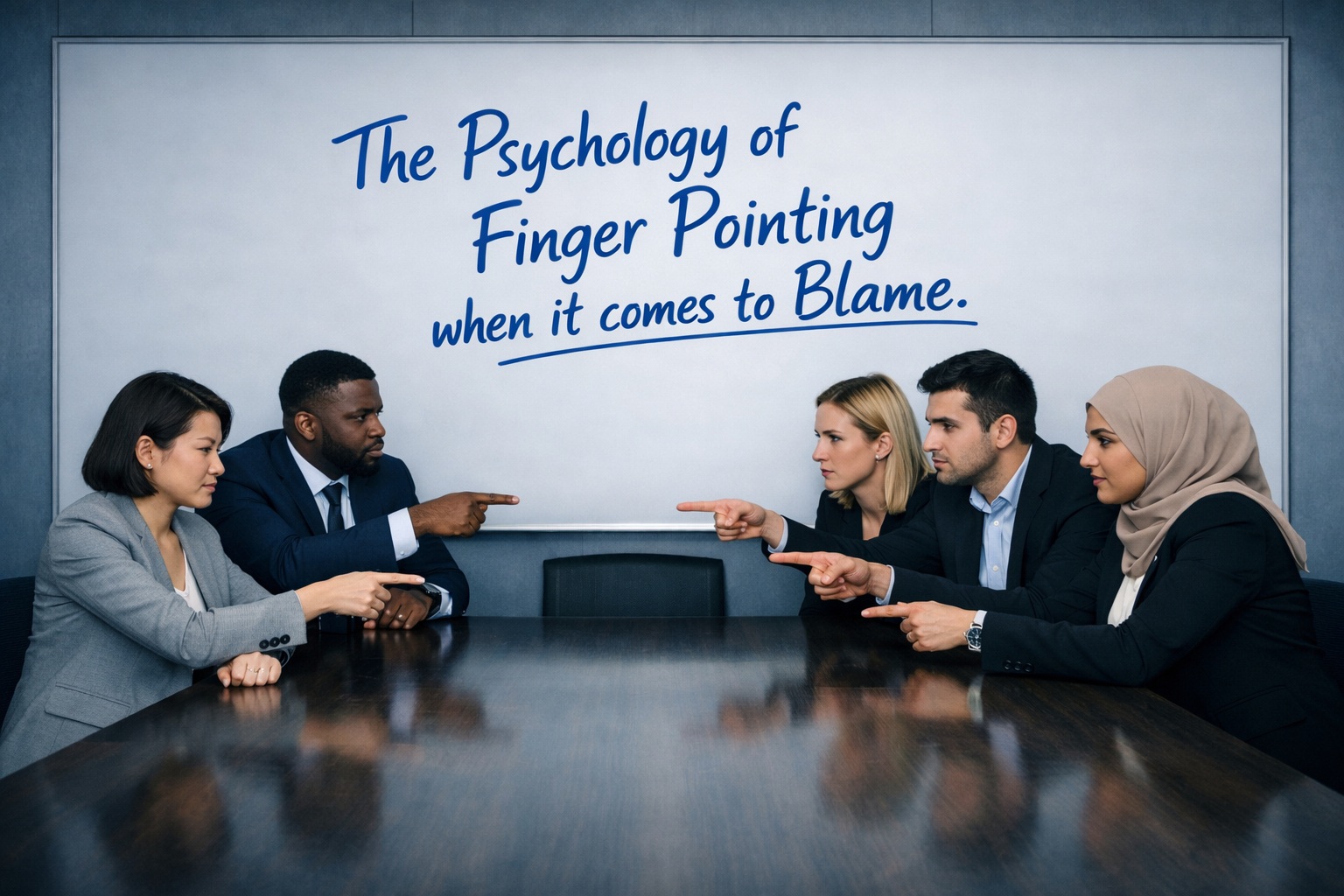
You get called into the room. Something broke. The owner wants to know what happened — and who’s responsible. Everyone’s eyes drop to the table.
I’ve been in that room. On both sides of it. And the thing nobody says out loud is that the search for a name feels good. It feels like progress. It feels like we’re getting somewhere.
We’re not.
Here’s what’s actually happening in your brain when you point a finger:
1. Fundamental Attribution Error — Lee Ross
Psychologist Lee Ross identified this decades ago: when something goes wrong, we blame the person. When it goes wrong for us, we blame the situation. Same event. Completely different lens. The system is almost always the real story — but the person is easier to see. Correct source: Ross (1977) formally introduced the concept.
2. Self‑Serving Bias — Shelley Taylor & Jonathon Brown
Research by Shelley Taylor and Jonathon Brown shows that people protect their identity by attributing failure outward. If they failed, you didn’t. Your story about yourself survives the room.
3. Illusion of Control — Ellen Langer
The illusion of control was discovered by Ellen Langer. It makes identifying a culprit feel like understanding. And Adam Galinsky’s work on power shows that low‑power states push people to seek certainty aggressively. If we know who, we feel like we know why. The feeling is real. The understanding rarely is.
4. Scapegoating — René Girard
Anthropologist René Girard documented how communities transfer collective anxiety onto a single target to restore stability. Tribes did it. Villages did it. Boardrooms do it. Once one finger points, the rest follow within seconds.
5. The Fairness Circuit — Fehr, de Quervain, Sanfey
Neuroscience from Ernst Fehr, Dominic de Quervain, and Alan Sanfey shows that the brain’s reward system activates when we perceive fairness being restored. Someone caused harm; someone should pay. Your brain rewards that math the same way it rewards food. It feels right even when it solves nothing.
None of this is weakness. It’s wiring. Every human in that room is running the same code.
Here’s the twist.
Finger pointing feels like finding the truth. It’s actually about avoiding pain.
The pain of admitting the system you built has a hole in it. The pain of sitting with a failure that doesn’t have a clean owner. The pain of realizing the answer is slower and harder than a name.
And as long as everyone in the room is avoiding that pain, the problem stays exactly where it is.
The name changes. The problem doesn’t.
See Part 2…… The Dynamics of Taking Ownership: Why Accountability Is Strategy, Not Sacrifice at: (davidcormier.ca on the blog tab, top left)
Referenced Researchers and Foundational Works
1. Fundamental Attribution Error — Lee Ross
Ross, L. (1977). The intuitive psychologist and his shortcomings: Distortions in the attribution process. In L. Berkowitz (Ed.), Advances in Experimental Social Psychology (Vol. 10, pp. 173–220). Academic Press.
2. Self‑Serving Bias — Shelley Taylor & Jonathon Brown
Taylor, S. E., & Brown, J. D. (1988). Illusion and well‑being: A social psychological perspective on mental health. Psychological Bulletin, 103(2), 193–210.
3. Illusion of Control — Ellen Langer
Langer, E. J. (1975). The illusion of control. Journal of Personality and Social Psychology, 32(2), 311–328.
Power & Certainty — Adam Galinsky
Galinsky, A. D., et al. (2003). Power and perspectives not taken. Psychological Science, 14(6), 632–638. Fast, N. J., Gruenfeld, D. H., Sivanathan, N., & Galinsky, A. D. (2009). Illusory control: A generative force behind power’s far‑reaching effects. Psychological Science, 20(4), 502–508.
4. Scapegoating — René Girard
Girard, R. (1977). Violence and the Sacred. Johns Hopkins University Press. Girard, R. (1986). The Scapegoat. Johns Hopkins University Press.
5. The Fairness Circuit — Ernst Fehr, Dominic de Quervain, Alan Sanfey
Fehr, E., & Gächter, S. (2002). Altruistic punishment in humans. Nature, 415, 137–140. de Quervain, D. J.-F., Fischbacher, U., et al. (2004). The neural basis of altruistic punishment. Science, 305(5688), 1254–1258. Sanfey, A. G., Rilling, J. K., et al. (2003). The neural basis of economic decision‑making in the Ultimatum Game. Science, 300(5626), 1755–1758.
Leave a Reply