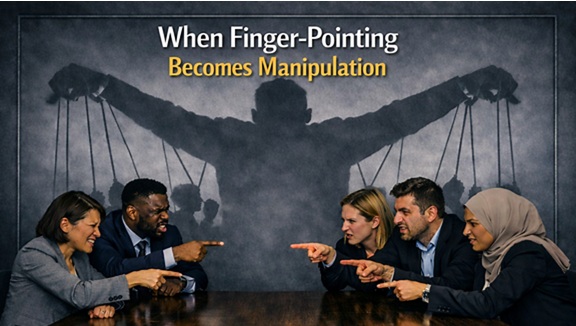
This is Part 3 in my series on blame and leadership.
In Part 1, I explained why our brains look for someone to blame when things go wrong. Blame feels like progress, even when it isn’t. In Part 2, I talked about responsible leadership — the kind where someone steps forward and says, “This happened on my watch,” so the group can focus on fixing the problem.
Now I want to talk about what happens when blame gets used to manipulate.
Your Brain Wants a Name
When something goes wrong, our brains try to quickly figure out who caused it. This is normal. Under stress, humans sort people into “us” and “them,” and we do it faster and more harshly.
Blaming an “out group” can even feel good. It reduces guilt and gives a sense of control. Anger can feel like relief.
This helped humans survive long ago. But today, some use it to manipulate people.
How a “Ready‑Made Enemy” Gets Built
People already deal with real stress — money pressure, fear about the future, and the feeling that things are getting worse. Manipulators don’t create these feelings. They simply attach a name or a group to them.
Our brains like simple explanations. So when someone gives us a name or one group to blame, it feels easier than facing a complicated truth.
This isn’t problem solving — it’s manufacturing an enemy to absorb frustration that was already building.
And the “enemy” isn’t always the weak. Modern research shows that manipulators can also target strong, respected, or competent people — especially when those people threaten their control.
This can include:
- high‑performing employees
- trusted experts
- respected community members
- leaders who take real responsibility
- people who reveal problems instead of hiding them
The person doing the pointing appears to be the protector.
Unity vs. Division
Responsible leaders unite people around shared problems. Manipulative leaders unite people around a shared enemy.
One asks, “How do we fix this together?” The other asks, “Who should we blame?”
Leaders who rely on enemies must keep those enemies alive. Without a threat, people stop following. So the “enemy characterization” never disappears — it just keeps being fed.
Fear keeps people loyal. Real problems don’t get solved. They get redirected.
Performing Leadership Instead of Practicing It
People who weaponize blame often look like leaders. They sound confident. They act strong. They claim to protect their people.
But their behavior shows the opposite.
Research on authoritarian leadership shows clear patterns: avoiding responsibility, increasing fear, and using emotional triggers instead of real solutions.
Responsible leaders create safety. These people create fear. Responsible leaders take responsibility. These people push it away. Responsible leaders solve problems. These people perform strength instead of doing the work.
They perform leadership instead of practicing it.
The Behavior That Disqualifies
Weaponizing blame isn’t a leadership style. It’s a warning sign.
The most common tactic is scapegoating — blaming one group for the problems of another. It works because it fits how the brain is wired. But it never solves anything.
When someone constantly points to a person or a group as “the problem,” especially using half‑truths, they show they cannot do responsible leadership work. They’ve chosen manipulation over responsibility.
That is not leadership.
Why It Eventually Fails
This pattern doesn’t last forever.
Studies show that when results are clearly bad, blaming outsiders makes the leader look weaker. People notice that the enemy keeps changing but the problems stay the same.
They notice nothing gets fixed.
Division may hold a group together for a while, but over time it wears people down and destroys trust.
How to Recognize the Pattern
You’ll see this in politics, workplaces, and communities.
Someone will take real pain and attach a name to it. They will present themselves as the solution. They will ask you to join their side.
Your brain will want to accept the explanation. It feels simple and comforting.
Before you do, ask:
- Do they name enemies instead of the truthful problems?
- Do they focus on who to oppose instead of what to build?
- Do they oversimplify complicated issues?
- Do they stir up fear instead of calm?
- Do they treat people like tools?
If the answer is yes to any of the questions, you’re not looking at leadership. You’re looking at performance — and manipulation.
The wiring that makes the explanation feel good isn’t your fault. The choice to exploit that wiring is theirs.
You can choose not to follow.
What Stepping Aside Really Means
Responsible leaders can step aside when needed. It doesn’t mean giving up. It means putting the group’s needs ahead of personal position.
Stepping aside takes more strength than pointing a finger. It takes more confidence than naming an enemy.
Weaponized blame makes the leader indispensable by making the threat permanent. Stepping aside makes the mission indispensable by making the leader temporary.
One of these is leadership. The other is self‑preservation dressed up as leadership.
The Standard That Matters
Real leadership isn’t about looking strong. It’s about doing the work:
- taking responsibility
- building unity
- turning fear into action
- stepping aside when the group needs it
Someone who weaponizes blame has shown they won’t do that work. They’ve chosen their own position over the people they claim to lead.
That choice disqualifies them — not because it never works in the short term, but because it is the opposite of what responsible leadership requires.
You cannot lead by creating the very thing leadership is supposed to resolve. And you cannot serve a majority by keeping them divided.
Further Reading
These works informed the psychological and leadership concepts discussed in this article.
Social Identity, Group Dynamics & Threat Response
- Tajfel, H., & Turner, J. (1979). Social Identity Theory.
- Cikara, M., & Van Bavel, J. (2014). Research on threat, emotional reactivity, and out‑group bias.
Scapegoating, Blame & Reward Pathways
- Petersen, M. B. (2010). The Dual Motive Model of Scapegoating.
- [Specify study] Duke University Research (2024) — Modern findings on scapegoating targets and shifting enemy construction.
Cognitive Ease & Simplification
- Kahneman, D. (2011). Thinking, Fast and Slow.
Political Psychology, Manufactured Enemies & Threat Vigilance
- Arendt, H. (1951). The Origins of Totalitarianism.
- Cavanaugh, T. (2009). [Add title of work]
- Hobfoll, S. et al. (2018). [Add title of study]
Authoritarian Leadership Patterns
- Herman, E., & Chomsky, N. (1988). Manufacturing Consent.
- Zimbardo, P. (2007). The Lucifer Effect.
Related Articles in This Series
- The Enemy I Was Taught to See
- Part 1: The Psychology of Finger Pointing When it Comes to Blame
- Part 2: The Dynamics of Taking Ownership
Leave a Reply