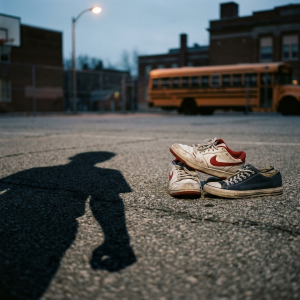
I was seventeen when Tom broke my nose on the school bus. Blood dripping down my jacket. The bus going silent. The driver yelling.
I remember thinking I should hit him back. That was the code. Someone hits you, you hit them harder.
But I didn’t. I’d been in enough fights to know how they ended. I walked away because of something my father once told me—words I didn’t fully understand at the time:
“The wise walks. The fool fights.”
I thought I was being wise. I thought I was taking the high road.
What I didn’t realize was that I was still playing the same game—I had simply chosen a different move.
The rules we learn without knowing
Where I grew up, fighting wasn’t optional. It was survival. There were rules of engagement. You didn’t hit someone smaller. You didn’t gang up. You fought “fair,” whatever that meant to a teenager trying to navigate a world that felt constantly hostile.
Tom was a bully. Everyone knew it. He picked fights, targeted the weak, and seemed to enjoy the fear he created.
To me, he wasn’t a person. He was a category. A label. The enemy.
I carried that label for years.
Then, much later, I learned the truth.
Tom had been abused as a child. Badly. The kind of abuse that leaves marks you can’t see but never fully heal from. The kind that turns victims into aggressors because that’s the only language they know.
Suddenly, the enemy had a story.
And I realized something that changed how I see the world:
I had been conditioned to see Tom as less than human long before I ever met him.
How we learn to manufacture enemies
We start learning who to fear before we can even speak.
“Don’t talk to strangers.” It’s one of the first lessons parents teach.
For decades, children have been conditioned through “stranger danger” campaigns that dramatically increase fear of unknown people—even though more than 90% of child abuse is committed by someone the child already knows (U.S. Department of Justice; Canadian Child Welfare Research Portal).
But the lesson sticks.
Strangers are dangerous. The unknown is a threat.
Children absorb fear vicariously. Infants learn about danger by watching their parents’ reactions. We don’t just inherit eye color. We inherit fears, biases, and enemy images.
By the time we’re teenagers, the conditioning is complete. We know who to fear, who to trust, who to see as fully human—and who to reduce to a label.
Bully. Criminal. Terrorist. Evil.
These words don’t just describe behavior. They erase humanity.
The psychology of seeing enemies
Dehumanization has been called “a psychological lubricant for violence” by social psychologists studying conflict and genocide.
When we stop seeing someone as a person with thoughts, feelings, and a history, empathy shuts down. Ethical constraints loosen. Harm becomes easier.
This isn’t new. It’s how humans have justified atrocities throughout history.
During conflicts, both sides create enemy images. Each side believes they are the good guys fighting the bad guys. Each side strips the other of complexity, context, and humanity.
The pattern is predictable:
- We perceive a threat.
- We create distance.
- We justify our response.
Real or imagined—it doesn’t matter.
The empathy gap we don’t see
Our brains are wired for in‑group empathy bias. Neuroscience research shows that mirror‑neuron activity increases when someone from our own group suffers, and decreases when the suffering person is seen as “other” (Amodio & Cikara, Nature Reviews Neuroscience).
Not because we’re bad people. Because we’ve been conditioned.
We don’t choose to dehumanize. We’ve been taught to do it so thoroughly that it feels natural.
What I didn’t see at seventeen
When Tom broke my nose, I didn’t see his humanity. I saw the threat. The bully. The enemy I had been trained to recognize.
I didn’t see the scared kid who had learned violence as a survival strategy. I didn’t see the victim of abuse repeating the only patterns he knew.
I didn’t see the cycle research now confirms: Adolescents who experience childhood abuse are significantly more likely to become bullies themselves (Baldry, Journal of Interpersonal Violence).
Tom wasn’t born a bully. He was shaped into one.
And I was shaped into someone who could only see the label, not the person underneath.
That’s what conditioning does. It gives us categories before we have context.
The stories we tell about enemies
Every culture has a version of the demonic enemy—the person who isn’t just wrong, but fundamentally evil. Inhuman. Beyond redemption.
This archetype shows up everywhere. It’s how we justify war, slavery, genocide, and everyday cruelty.
We tell ourselves that some people are different. That they don’t feel pain the way we do. That they don’t love their children the way we love ours.
We create these stories because they make difficult actions easier.
It’s hard to harm someone you see as fully human. It’s much easier to harm someone you’ve been taught to fear.
Breaking the pattern
I can’t go back and see Tom differently at seventeen.
But I can choose to see people differently now.
Awareness doesn’t erase conditioning. It creates space—a pause between the automatic reaction and the conscious choice.
That space is where change begins.
When I catch myself reducing someone to a label, I pause. I ask:
Am I seeing a person, or am I seeing the enemy I was taught to see?
Sometimes the answer is uncomfortable. But asking the question interrupts the pattern.
It creates room for complexity, context, and humanity.
This isn’t about excusing harm. Tom breaking my nose was wrong. Abuse is wrong. Violence is wrong.
But understanding how someone became capable of harm is different from excusing it.
One allows for accountability and change. The other keeps the cycle alive.
The question worth asking
You’ve been conditioned too. We all have.
You learned who to fear, who to trust, who deserves your empathy and who doesn’t. You learned it from parents, teachers, media, culture, and experience.
You learned it so young and so thoroughly that it feels like truth instead of conditioning.
The question isn’t whether you’ve been conditioned. You have.
The question is whether you’re willing to notice it.
Next time you encounter someone you’ve labeled—a bully, a criminal, an enemy—pause.
Ask yourself:
Am I seeing a person, or am I seeing the category I was taught to see?
The answer might surprise you.
It might reveal that the enemy you’re fighting was manufactured long before you met them. That the threat you perceive was shaped by conditioning you didn’t choose and might not even recognize.
And it might open up a different possibility:
Seeing someone’s humanity doesn’t require excusing their actions. It simply requires recognizing that they’re human.
That recognition is where change begins.
Not because it’s easy. Not because it feels good. But because it’s the only way to break a cycle that has repeated itself throughout human history.
The wise walks. The fool fights.
My father was right.
But wisdom isn’t just walking away from a fight. It’s recognizing when the enemy you’re fighting was never really the enemy at all.
Just a person. Conditioned, like you. Trying to survive in a world that taught them the same lessons you learned.
The only difference is which side of the label you ended up on.
References
U.S. Department of Justice, Office of Juvenile Justice and Delinquency Prevention. (2000). Child Abuse Reported to the Police. Available at: https://ojjdp.ojp.gov/library/publications/child-abuse-reported-police (ojjdp.ojp.gov in Bing)
Baldry, A. C. (2003). Bullying in schools and exposure to domestic violence. Journal of Interpersonal Violence, 18(4), 361–382. Available at: https://journals.sagepub.com/doi/10.1177/0886260502250835 (journals.sagepub.com in Bing)

Leave a Reply