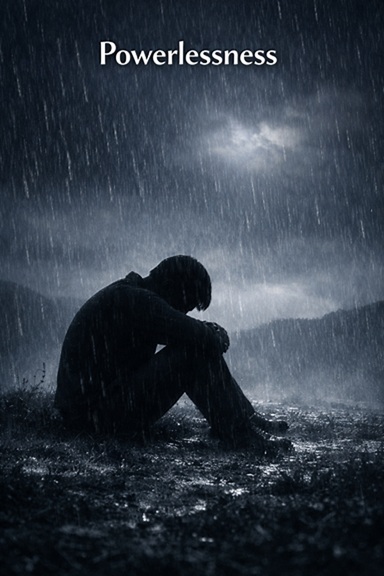
When your heart breaks, when someone you love gets sick, when you lose a job you gave everything to — the pain hits deeper than most people can explain. It’s not just sadness. It’s not just fear. It’s the moment life stops responding to you. Something happens that you can’t influence, and suddenly your choices don’t seem to matter.
Different stories, same core experience: a loss of control. And that loss of control triggers something deeper — the biological state we call powerlessness.
That moment when your effort changes nothing. When your actions have no impact. When life becomes something, you endure instead of something you shape. It can break even the strongest people. Some never fully come back from it. They shrink from life, from others, even from themselves.
But here’s what most people don’t realize:
Powerlessness isn’t just an emotion. It’s a biological event happening inside your brain and body — and it begins the moment your mind registers that you’ve lost control.
The Experiment That Revealed the Truth
Before we go further, a quick note: the experiment I’m about to describe is uncomfortable, and I don’t support how it was conducted. But the insight it uncovered is crucial.
In 1967, psychologists Martin Seligman and Steven Maier ran a study that changed how we understand human behavior. They exposed dogs to electric shocks the dogs couldn’t escape. Later, they placed the same dogs in a new situation where escape was easy — all they had to do was jump over a low barrier.
Most didn’t even try.
They lay down and accepted the pain, even though freedom was right in front of them. The earlier experience of having no control had changed them. They had learned that nothing they did mattered.
They weren’t trapped by the barrier. They were trapped by the belief that they had no power — a belief formed only after experiencing true loss of control.
This became known as learned helplessness, and it opened the door to decades of research showing just how deeply powerlessness affects the mind and body of human beings also.
Giving Up Isn’t Learned — It’s the Default
Here’s the part that surprises most people:
Your brain’s default response to uncontrollable situations — to the moment you lose control — is shutdown.
When you face something you can’t change, your prefrontal cortex — the part of your brain responsible for decision-making and action — automatically pulls back. It shifts you toward withdrawal, stillness, and passivity.
Your brain has to learn the opposite: that your actions matter, that you have influence, that control is possible.
When you feel in control, your prefrontal cortex blocks that shutdown response and keeps you moving forward. But when nothing you do makes a difference, that block doesn’t happen.
This isn’t weakness. This is biology.
What Powerlessness Does to Your Brain
Researcher Dacher Keltner found that powerlessness flips your brain into what he calls the inhibition system — a mode built for caution and survival.
In this state:
• You scan for danger constantly
• You become hyper-aware of what others think
• You feel anxious, frozen, and small
When people feel powerful, the opposite happens. The brain switches into the approach system — the mode built for confidence, action, and forward movement.
It’s like a switch. Power and powerlessness put your brain in two completely different operating modes.
Powerlessness Shrinks Your Thinking
It doesn’t stop at feelings. It affects your cognitive abilities.
Researchers Adam Galinsky and Pamela Smith found that when people feel powerless, three core mental functions weaken:
• Memory — harder to hold and use information
• Focus — harder to stay on task
• Planning — harder to think ahead and make decisions
Your creativity drops. Your problem-solving slows. Your world feels smaller.
This isn’t a character flaw. It’s what happens when your brain is overloaded by the experience of losing control — the very thing that triggers powerlessness.
You Start to Disappear
Powerlessness also changes how you show up around others.
You speak less. You share fewer ideas. You take fewer risks. You start to believe your voice doesn’t matter — so you stop using it.
And that creates a trap:
• The less you speak, the less visible you become
• The less visible you are, the less influence you have
• The less influence you have, the more powerless you feel
People who feel powerless often withdraw from the very relationships that could help them heal. They fade from their own lives, quietly and slowly.
Your Body Pays the Price
Powerlessness doesn’t stay in your mind. It moves into your body.
Neuroscientist Bruce McEwen discovered that long-term uncontrollable stress creates allostatic load — slow, cumulative wear-and-tear on your body’s systems.
When you feel out of control:
• Stress hormones rise and stay high
• Your heart works harder
• Your immune system weakens
• Your body stays stuck in survival mode
Over time, this increases the risk of chronic illness, fatigue, depression, and heart disease.
Powerlessness doesn’t just hurt emotionally. It physically wears you down.
The Path to Depression
Researchers have traced a clear chain:
Loss of Control → Powerlessness → Chronic Stress → Learned Helplessness → Depression
And untreated depression increases the risk of serious physical illness.
This is why powerlessness is so much more than a bad feeling. It’s a biological cascade that builds over time if nothing interrupts it.
The Good News: Even a Small Amount of Control Helps
Here’s the part that changes everything:
You don’t need to fix your whole life to start healing. You just need one moment of control.
Studies show that even a single experience of being in control begins to reverse the shutdown response. The brain starts to rebuild. The action system comes back online.
It can be tiny:
• Choosing to go for a walk
• Cleaning one corner of a room
• Making one decision that’s entirely yours
Your brain needs new memories of control. They don’t have to be big. They just have to be real.
Motivation doesn’t come first. Action does.
Why This Changes Recovery
Once you understand what powerlessness does to you, everything shifts.
You stop blaming yourself for shutting down. You see that your brain was responding exactly as it’s designed to.
You stop waiting to “feel motivated.” You realize motivation follows action, not the other way around.
You stop searching for one big solution. You start looking for the smallest thing you can control today.
Recovery isn’t about thinking positively. It’s about rebuilding your sense of control — one small choice at a time.
Coming Next: What Power Actually Does
Now that we’ve looked at what powerlessness takes from you, the next question is simple:
What happens when you get your sense of control back?
In Part 3, we’ll explore the science of power — how it changes your brain, your behavior, your relationships, and your ability to lead.
Because if powerlessness is the problem, power is the beginning of the answer.
Key Research Behind This Article
• Seligman & Maier (1967) — Learned helplessness
• Maier & Watkins (2005) — Neuroscience of control
• Keltner, Gruenfeld & Anderson (2003) — Approach–inhibition theory
• Smith, Jost & Galinsky (2008) — Cognitive effects of powerlessness
• McEwen (1998) — Allostatic load
• Abramson, Seligman & Teasdale (1978) — Helplessness and depression
• Langer & Rodin (1976) — Health benefits of perceived control
• Amat et al. (2006) — Control and stress resilience
Leave a Reply